
The Unshakable God Who Was Once Fooled
We often imagine gods as perfect beings, beyond deception. But what if one of the most powerful deities in the Hindu pantheon, Lord Shiva himself, was once outsmarted by Mohini, the enchanting female avatar of Lord Vishnu, who tricked him into giving away the sacred nectar of immortality. This mythological tale is rooted in the story of the churning of the ocean, where the gods and demons collaborated to produce the elixir of life. The story goes that Mohini was tasked with distributing the nectar, but the demons tried to steal it, and in the chaos, Shiva was deceived by Mohini's charms. It's a surprising story, one that challenges our assumptions about divine power. Divine beings, it seems, are not immune to the forces of maya, or illusion, that shape the world. That's what makes this story so intriguing.
The Cosmic Deception — How Vishnu Tricked Shiva
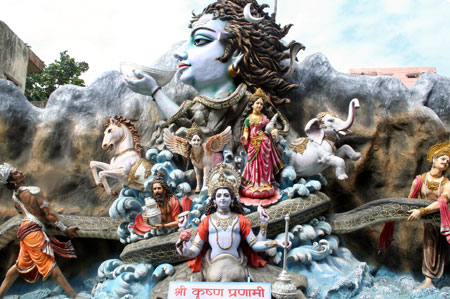
Shiva's consumption of the Halahala poison during the Samudra Manthan, or Churning of the Ocean of Milk, is a pivotal moment in Hindu mythology, as it saved the universe from destruction. The churning produced not only the poison, but also the nectar of immortality, Amrita, which was meant to be distributed among the gods. However, the demons tried to steal the nectar, and in the chaos, Vishnu intervened in his Mohini avatar, a enchanting female form. Mohini's task was to distribute the nectar, but she also had to trick the demons and ensure the gods received it. You've probably heard that Mohini tricked the demons, but what's more surprising is that she also tricked Shiva, who was enchanted by her charms. This led to Shiva drinking a portion of the nectar meant for the gods, and subsequently, he became so smitten with Mohini that he united with her, resulting in the birth of Harihara, a combined deity of Vishnu and Shiva. It's not a sign of Shiva's weakness, but rather a cosmic arrangement orchestrated by Vishnu for a specific divine outcome. The story highlights that even divine beings can be deceived by the forces of maya, or illusion, and that's what makes this myth so intriguing. The birth of Harihara is often seen as a symbol of the unity between Vishnu and Shiva, two of the most powerful gods in the Hindu pantheon, and it's a reminder that divine power is not always about strength, but about the complex interplay of cosmic forces. That's what makes the story of Shiva and Mohini so fascinating, it challenges our assumptions about divine power and the nature of reality.
Beyond Omnipotence — Rethinking Divine Power
The story of Shiva and Mohini is a striking example of how even the most powerful deities can be tricked, and it challenges our common notion of divine omnipotence. It's surprising to see Shiva, often considered the destroyer of the universe, being enchanted by Mohini, a female avatar of Vishnu. This episode highlights that divine power in Hinduism operates within the cosmic order, or Dharma, and is subject to the divine play, or Lila. It's not about absolute omnipotence, but about the complex interplay of cosmic forces.
Divine power is often misunderstood as absolute and unchangeable, but Hindu scriptures and Puranas portray deities with human-like emotions and vulnerabilities. Shiva's enchantment with Mohini shows that even powerful deities are subject to the influence of Maya, or illusion. This doesn't diminish their divinity, but rather makes them relatable and more accessible to humans. You've probably noticed that Hindu deities are often depicted with flaws and weaknesses, which is a deliberate attempt to show that their power is not absolute.
In contrast to the Western philosophical concept of an all-powerful, unchangeable God, Hindu deities are dynamic and often paradoxical. They can be both powerful and vulnerable, wise and foolish, at the same time. That's what makes them so fascinating and complex. It's interesting to see how this nuanced understanding of divine power can change our perspective on the nature of reality and the role of deities in the universe. The story of Shiva and Mohini is a reminder that divine power is not always about strength, but about the subtle and often mysterious interplay of cosmic forces.
The Power of Bhakti — How Devotion Outsmarted the Trickster

The most striking aspect of the Shiva and Mohini story is how it turns the concept of divine power on its head, showing that even the gods can be tricked, and that's what makes it so compelling. Shiva's reaction to being tricked by Mohini is particularly interesting, as he eventually accepts the situation, leading to their union and the birth of Harihara, an outcome that seems to be driven by cosmic necessity and perhaps even divine will. It's clear that this wasn't just a random event, but rather a deliberate move in the grand scheme of things, highlighting the complex interplay of cosmic forces.
This narrative doesn't diminish Shiva's power, but rather elevates the power of Vishnu's Maya, showcasing a balance of powers that's essential to the functioning of the universe. The story demonstrates that the divine is capable of strategic actions, like Vishnu's trick, that serve a greater purpose, a purpose that sincere devotion can sometimes align with or even influence. The birth of Harihara, a fusion of Shiva and Vishnu, represents a balance of opposing forces, underscoring the idea that cosmic balance and evolution are the ultimate goals of divine plans.
The story's enduring popularity lies in its ability to convey that even when divine plans involve deception or complex maneuvers, the underlying purpose is always cosmic balance and evolution. This narrative shows that the divine is not a static force, but a responsive presence that can adapt and evolve, often in response to profound devotion. It's this dynamic interplay between the divine and human devotion that makes the story so captivating, and it's what allows us to see the world as a complex, ever-changing web of relationships between different forces and entities. The power of Bhakti, or devotion, is what ultimately drives this process, and it's what allows us to connect with the divine in a meaningful way, even when the divine itself seems to be operating in mysterious and unpredictable ways.
References - The Untold Story of Parvati's Disguise: Shiva Tales - YouTube
The story of Parvati's disguise is a fascinating one, it's a tale that shows even the gods can get tricked. You've probably heard it before, but it's worth revisiting, especially in the context of Shiva's story. Parvati, determined to test Shiva's devotion, disguises herself as an old woman and approaches him. Shiva, unaware of her true identity, proceeds to criticize her, not realizing he's speaking to his own wife. This story highlights the complexities of divine power, and how even the gods can be fooled. It's a reminder that power is not absolute, and that even the most powerful beings can be tricked. The power of Bhakti is what ultimately drives this process, and it's what allows us to connect with the divine in a meaningful way. That's what makes the story of Shiva and Parvati so captivating, it's a complex web of relationships between different forces and entities. The fact that Shiva, a god, can be tricked by his own wife, shows that divine power is not always straightforward, and that's what makes it so interesting. It's a story that challenges our assumptions about the nature of power and the divine, and it's one that continues to captivate us to this day, leaving us to ponder the mysteries of the universe.
Frequently Asked Questions
Q: Was Shiva actually tricked, or was it part of a divine plan? Shiva's enchantment by Mohini was a complex event that can't be reduced to a simple trick, it was a divine arrangement that highlights the power of Maya. This story shows that even powerful deities can be subject to Maya, illustrating a complex cosmic play. The line between trickery and divine plan gets blurred in this context.
Q: Does this mean Shiva is less powerful than Vishnu? The story doesn't imply a hierarchy of power between Shiva and Vishnu, it showcases their different forms and functions of divine power. Vishnu's strategic use of Maya and Shiva's capacity for accepting and integrating various cosmic forces are both unique aspects of their power. This difference in approach doesn't make one more powerful than the other.
Q: How does this story relate to the concept of divine infallibility? This story challenges the idea of absolute infallibility by portraying deities with complex interactions and motivations, it suggests that divine perfection lies in cosmic purpose and grace. The story portrays deities as susceptible to illusion, which raises questions about the nature of divine power and its relationship to the cosmos. The concept of divine infallibility becomes more nuanced and complex in this context.
The Divine Dance of Power and Playfulness
The story of Shiva being tricked by Mohini reveals that divine power is not absolute, it's a force that operates within cosmic laws and divine play. This challenges our assumptions about the nature of power and the divine. The narrative teaches that even gods can be influenced by Maya, and their actions are often part of a grander design. Devotion plays a profound role in navigating these divine mysteries. Reflect on the myths that shape your understanding of divinity and consider how these stories offer deeper wisdom beyond simple notions of power. You've been given a glimpse into the dynamic interplay between divine forces, now it's up to you to ponder the mysteries of the universe.
Sources & References
- The Untold Story of Parvati's Disguise : Shiva Tales - YouTube
- Is Shiva's Legend of Tripurantak the MOST EPIC Story Ever Told ...
- When a God Desired Too Much: The Untold Myth of Shiva's Wrath
- The Hidden Truth About Mahadev That Will Change How You See Life
- Rudra Shiva Returns to Destroy the 3D World in 2026 - YouTube
- WHO Was Shiva And Why He DESTROYS Everything - YouTube
- Why Shiva Became Nataraj? The Cosmic Dance That Controls Time ...
- Prayer to gods for blessings and protection - Facebook