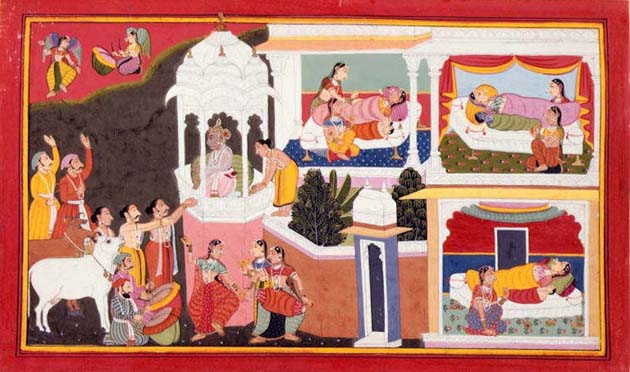

The Melody That Wasn't for Everyone
Every child who has heard tales of Krishna knows Radha, the gopi whose love for him is often seen as the epitome of devotion. But what if there was another gopi, one who refused the divine flute's call, only to become a disciple of unparalleled depth? In the traditional narrative, Radha and Krishna's divine love is a central theme, symbolizing the longing of the individual self for union with the divine. This story has been passed down for generations, captivating the hearts of many with its beauty and intensity. Chandrika, on the other hand, is a lesser-known figure, a gopi who initially resisted Krishna's allure for reasons that go beyond simple shyness, her refusal stemming from a deep sense of self and purpose. It's this unique aspect of her character that sets her on a different path, one that explores the integration of personal will with divine will. Chandrika's story is one of profound devotion, where the boundaries between the self and the divine are tested and transformed. Her journey raises questions about the nature of discipleship and spiritual realization.
The Ecstatic Dance of Radha and Krishna

The ecstatic dance of Radha and Krishna is a spectacle of divine love that has captivated the hearts of devotees for centuries, with Radha embodying the ideal of prema, or divine love, that seeks complete union and surrender with Krishna. This lila, or divine play, is rooted in the concept of madhurya-bhava, which represents the pinnacle of devotion, characterized by an ecstatic and often overwhelming love that transcends worldly boundaries. You've likely heard stories of Radha's unwavering dedication to Krishna, and how she's often portrayed as his spiritual counterpart, but what's interesting is how this relationship is seen as a metaphor for the soul's longing for the divine and the divine's responsive love. Chaitanya Mahaprabhu's Vaishnavism interprets this lila as a representation of the divine's desire to reconnect with the soul, and the soul's yearning for union with the divine. That's a powerful idea, and it's one that has driven many devotees to follow this path of devotion, which can be so intense that it appears to exclude other forms of spiritual engagement, leaving one to wonder if there's room for other expressions of faith in this all-consuming love. The intensity of this devotional path is a double-edged sword, offering a depth of spiritual experience that's hard to find elsewhere, but also risking a kind of spiritual exclusivity that can be alienating to those who don't share this particular passion. It's a tension that's at the heart of the Radha-Krishna lila, and one that sets the stage for the story of Chandrika, a gopi who refused Krishna's flute and forged a different path to spiritual realization.
Chandrika's Hesitation — A Different Kind of Love

Chandrika's story is a fascinating anomaly in the usual narrative of gopi devotion, where she hears Krishna's flute but consciously chooses not to run to him, unlike her companions. This hesitation is not driven by a lack of love or devotion, but rather a deliberate act of vairagya, a detachment from the immediate ecstatic call that sets her apart from the other gopis. It's a moment of internal deliberation, where Chandrika weighs her desire to follow the sound of the flute against a deeper sense of duty and understanding.
Scriptural interpretations of Chandrika's hesitation vary, with some seeing it as a form of fear, while others view it as a nascent form of intellectual discrimination, or viveka, that allows her to distinguish between the immediate allure of Krishna's flute and a more profound connection with the divine. This distinction is crucial, as it highlights Chandrika's refusal as not a rejection of Krishna, but a different, perhaps more mature, way of approaching the divine.
In contrast to the immediate, uninhibited surrender of other gopis, Chandrika's choice is a deliberate act that underscores her desire for deeper understanding rather than immediate sensory or emotional fulfillment. It's a choice that's rooted in a desire to comprehend the nature of her own devotion, and to approach Krishna with a sense of clarity and purpose that's distinct from the spontaneous, all-consuming passion of her companions.
This initial refusal ultimately becomes a defining characteristic of Chandrika's spiritual journey, one that's marked by a deepening understanding of the divine and a profound sense of detachment that allows her to approach Krishna with a sense of freedom and clarity. Chandrika's story raises important questions about the nature of devotion and the path to spiritual realization, and it's a reminder that the journey to the divine is not always a straightforward or easy one, but one that requires patience, discernment, and a willingness to challenge our own assumptions and desires.
From Refusal to Revelation — Chandrika's Path to Discipleship

Chandrika's refusal to be swayed by Krishna's flute marked a turning point in her spiritual journey, as Krishna, recognizing her unique disposition, began to engage her not as a lover, but as a guru or spiritual guide. This shift in dynamic allowed for a profound dialogue of wisdom to unfold, with Krishna imparting teachings that focused on aspects of divine knowledge, the nature of reality, or Brahman, and the path of jnana-yoga, integrated with bhakti. You've likely heard of jnana-yoga as a path of knowledge, but what's less discussed is how it can be intertwined with devotion, creating a powerful synergy that accelerates spiritual growth.
Krishna's answers to Chandrika's questions formed a pedagogical relationship, marking her transition from a romantic devotee to an enlightened disciple. Chandrika's inquiries were sharp and insightful, driven by a desire to understand the deeper truths of existence, and Krishna's responses were tailored to her unique perspective, guiding her through the complexities of divine knowledge. That's what made their dialogue so remarkable - it wasn't just a one-way transmission of wisdom, but a dynamic exchange that pushed Chandrika to confront her own assumptions and limitations.
As Chandrika delved into the teachings of Krishna, she began to grasp the philosophical significance of her own path, one that showed divine union could be achieved not only through ecstatic love, but also through contemplative wisdom and intellectual discernment. This offered an alternative to the overwhelming madhurya-bhava, a dominant emotional tone in Krishna's relationships with his devotees, and one that Chandrika had initially resisted. Her journey demonstrated that spiritual realization is not a one-size-fits-all proposition, but rather a multifaceted process that can unfold in different ways, depending on the individual's disposition and inclinations. It's a reminder that the journey to the divine is full of unexpected twists and turns, and that sometimes, it's the refusal to follow the beaten path that leads to the most profound revelations.
The Many Mansions of Divine Love
The divine romance of Radha and Krishna represents one, albeit central, path of devotion. Chandrika's story reveals that spiritual realization can also be attained through contemplation, discernment, and a guru-disciple relationship with the Divine. Her refusal of the flute's immediate call led not to separation, but to a deeper, more integrated understanding of Krishna and His divine play. This nuance is crucial, as it suggests that spiritual growth can occur in many ways. Reflect on your own spiritual journey: is there a call you've hesitated to answer, perhaps seeking a deeper meaning or a different approach to connection. You've likely encountered moments where the usual paths didn't feel right, and that's okay. It's in these moments of uncertainty that you can discover a more authentic, personal connection to the divine.
Sources & References
- Gopi Prem and the Unheard Leelas of Radha Krishna from the Shrimad Bhagavatam
- gopis and Krishna's flute Archives - For the Pleasure of Lord Krishna
- Radha and Krishna’s fine gopis • inbrindavan.com
- Why did Shri Krishna break his flute after the death of Radha? - Quora
- The Perils of Becoming a Gopī - Embodied Philosophy
- Radha - Wikipedia
- Krishna | Hinduism, Story, Meaning, Description, & Legends | Britannica
- Radha Krishna - Wikipedia